
Behavioural Support
Helping dogs and their families navigate fear, anxiety, reactivity and challenging behaviours
Living with a dog who struggles with the world around them can feel overwhelming. Whether your dog barks and lunges on walks, worries about people or dogs, struggles to cope with change, or finds everyday life difficult, support is available.
At Parker’s Canine Training, we take a behaviour-led approach, focusing on why a behaviour is happening, not just how to stop it.
Together, we’ll build a plan that helps your dog feel safer, more confident and better able to cope.
Does your dog struggle
Does your dog struggle
You may be looking for support if your dog:
-
Reactivity can be challenging and often leaves owners feeling unsure of what to do next. A dog who barks, lunges or struggles around triggers may be experiencing fear, frustration, excitement, uncertainty or feeling overwhelmed.
We’ll look at what your dog is communicating, identify their triggers and create a personalised plan using evidence-based behaviour modification to help them feel safer and more confident.
-
Some dogs find everyday experiences difficult, whether that’s new people, environments, sounds, handling or changes in routine. We’ll work at your dog’s pace to build confidence, resilience and positive associations.
-
Rescue dogs often need time to adjust and understand their new world. Support can help you recognise their needs, reduce stress and build a relationship based on trust and communication.
-
Loud or unexpected sounds can feel overwhelming for some dogs. Fireworks, thunderstorms, household noises, vehicles, construction sounds or even everyday sounds can trigger fear and anxiety.
Dogs experiencing noise fears may hide, shake, pace, bark, try to escape, become unable to settle or become more reactive in other situations.
We’ll help you understand what your dog is experiencing and create a personalised plan using gradual exposure, positive associations and confidence-building strategies to help them feel safer.
-
A change in behaviour can sometimes be a sign that something has changed for your dog, including their environment, emotions or physical wellbeing. This is where vet checks are necessary. We’ll help you look at the bigger picture and decide what support is needed.
My approach
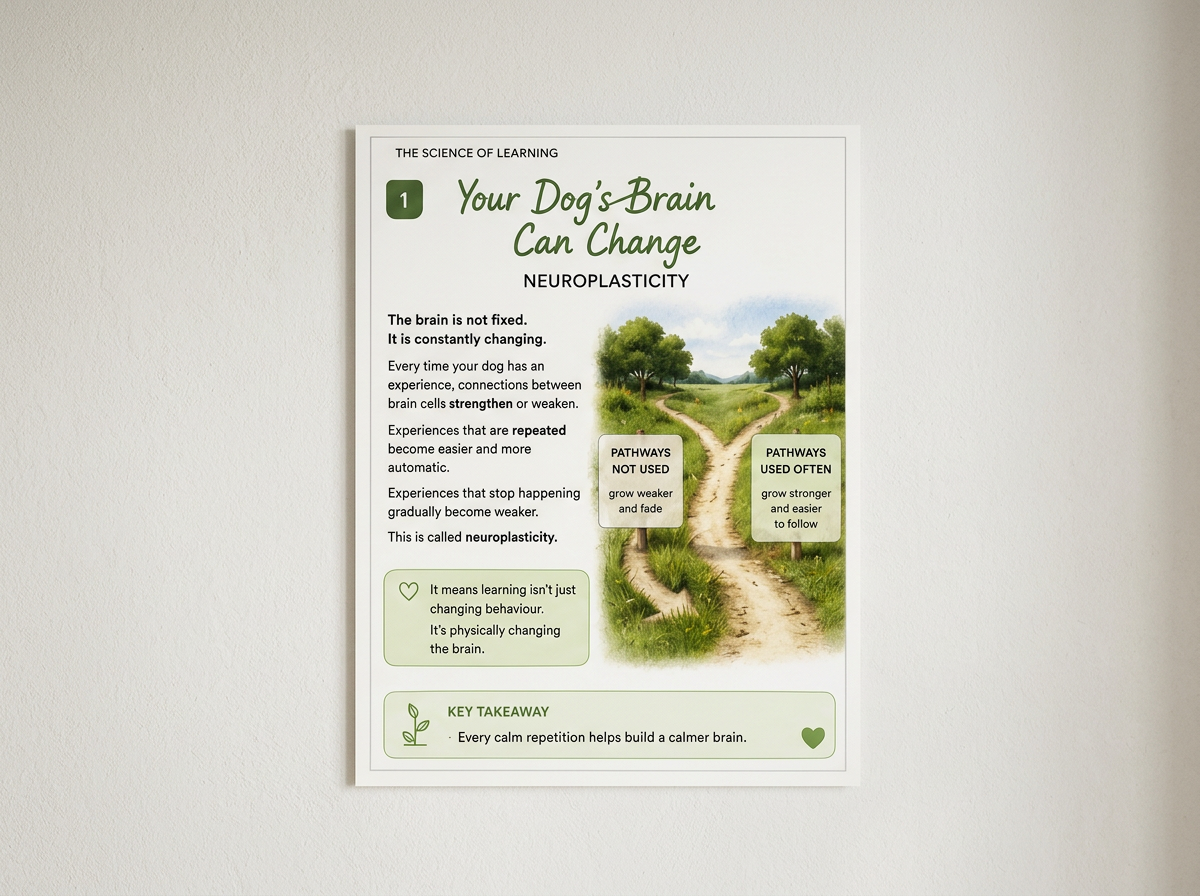
Every dog is an individual. Behaviour is influenced by many factors including genetics, learning history, environment, emotions and physical wellbeing.
I use evidence-based behaviour modification approaches including:
✓ Understanding your dog’s emotional state
✓ Identifying triggers and patterns
✓ Creating appropriate management strategies
✓ Desensitisation and counter-conditioning
✓ Building confidence and resilience
✓ Teaching practical skills for real-life situations
The goal isn’t simply to stop a behaviour — it’s to help your dog develop better coping strategies.
How behavioural support works
Getting started
Every behaviour journey begins with understanding. We'll work together, step by step, to understand your dog's behaviour, create a personalised plan and support you as you put it into practice.
Step 1. Behaviour Assessment | £75
Your Behaviour Assessment is the starting point for understanding what's really going on.
The assessment takes place across two one-hour sessions, one at my training field and one in your home. We'll take a detailed history and look at your dog's behaviour, environment, routines, previous experiences and any factors that may be contributing to or maintaining the behaviour.
By observing your dog in different environments and looking beyond the behaviour itself, I can build a much fuller picture of what's happening, why it may be happening and what your dog needs from us next.
2. Your Personalised Action Plan
Following your assessment, you'll receive a tailored action plan designed specifically for you and your dog.
We'll look at what we've learned from the assessment, what we need to work on and what you can begin doing straight away. Your plan may include practical management strategies, changes to the environment and individual training exercises, along with clear next steps to help you move forward.
3. Ongoing Behaviour Coaching
Behaviour change takes time, and the right level of ongoing support will look different for every dog.
Following your assessment and action plan, we'll discuss the most appropriate next step. For some families, the assessment and plan may be all the support they need. Others may benefit from more structured, ongoing help.
Where ongoing support is recommended, we'll choose the programme that best fits your dog's individual needs. Your £75 Behaviour Assessment fee will be credited towards the cost of your programme, so you won't pay twice for getting started.
From First Assessment to Lasting Change
Behaviour change isn't about quick fixes—it's about understanding your dog, building trust and creating practical solutions that work for your family. Whatever challenges you're facing, you don't have to navigate them alone.
Behaviour Support Programme
What might we work on?
Depending on your dog, your programme may include support with fear and anxiety, reactivity, confidence, resource guarding, frustration, difficulty coping with novelty or other behaviour concerns.
For a fearful or anxious dog, our early work might focus heavily on feeling safe enough to explore. We may use Movement Puzzles, confidence-building activities, enrichment, sniffing and sensory exploration, novel objects and surfaces, predictable pattern games and carefully planned Confidence Challenges.
For a dog who struggles around particular triggers, we might work on distance and thresholds, disengagement, Look At That, pattern games, counterconditioning and carefully planned exposure, alongside practical management strategies that prevent your dog continually rehearsing behaviours we're trying to change.
For other dogs, the work might look completely different.
Understanding what's driving the behaviour
We're not simply going to try to stop what your dog is doing.
We'll look at the antecedents, behaviour and consequences. What happens beforehand? What does your dog do? What happens afterwards? What is the environment contributing? What does your dog's body language tell us? Are there patterns to when the behaviour occurs?
We'll also consider your dog's breed, previous experiences, physical comfort, emotional state and individual character.
Once we understand more about why the behaviour is happening, we can begin changing the things around it and teaching your dog safer, more appropriate ways to navigate those situations.
Your programme may include
Individual behaviour-modification and training sessions
Understanding your dog's body language and communication
Management and environmental changes
Counterconditioning and carefully planned exposure
Confidence-building and Movement Puzzles
Pattern games, including exercises such as 1-2-3
Look At That and disengagement work where appropriate
Settling, sniffing, sensory exploration and enrichment
Lead-handling and my Sarah Walk approach
Confidence Course and enrichment areas where appropriate
Carefully controlled work around triggers
Practical skills for navigating everyday situations
Personalised activities and Confidence Challenges between sessions
Not every dog will need everything on this list. We'll choose the tools that make sense for your dog.
Support doesn't stop when the session ends
Behaviour change happens in everyday life, not just during our sessions together.
Between sessions, you can send me updates, upload videos for feedback and ask questions. This allows me to see what's happening at home and out on walks, celebrate what's working and adjust the plan when something isn't.
You'll have clear activities to work on between sessions, along with resources and guidance to help you understand what we're doing and why.
Your six sessions don't need to be squeezed into six consecutive weeks either. We can work more closely together initially and gradually spread sessions out as you and your dog become more confident.
Already completed your Behaviour Assessment?
Your £75 Behaviour Assessment is credited towards the £285 programme, leaving £210 to pay if we decide ongoing support is the right next step.
For some dogs and families, the assessment and action plan may be enough. Others benefit from having me alongside them for longer.
We'll make that decision based on what you and your dog actually need.
Small steps. Practical support. A programme built around your dog.
Helping your dog feel safe enough to learn. I'm just keeping that as a tagline because I want to remember it.
Individual support for the dog in front of us
6 × 45-minute sessions · £285 · Ongoing support between sessions
Behaviour isn't one-size-fits-all. Two dogs can display exactly the same behaviour for completely different reasons — and two dogs experiencing similar emotions may express them in completely different ways.
One dog may move away when they're worried. Another may bark, lunge or rush towards the thing they're concerned about. A dog who pulls on the lead may be excited, frustrated, anxious or overwhelmed. What we see is only part of the picture.
That's why my Behaviour Support Programme isn't built around a label. It's built around your individual dog.
Following your Behaviour Assessment, we'll use what we've learned about your dog's history, environment, behaviour and individual needs to create a programme specifically for them.
A little note about behaviour
Behaviour change is not a quick fix. Dogs are not being “naughty” or “stubborn” — behaviour is communication.
By understanding what your dog is experiencing, we can create meaningful, lasting change.