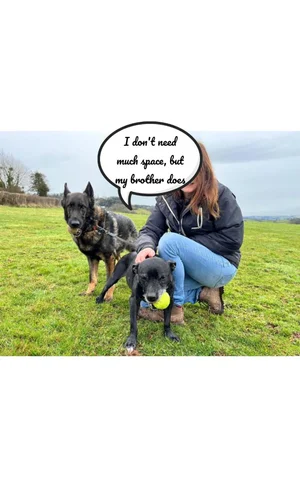
Conflicted Communication: We Are Only Human
“He knows better.”
I hear this quite a lot.
And if you live with an adolescent dog, you've probably thought it at some point too.
You have taught them not to jump up.
You've asked them a thousand times to get off the kitchen counter.
They know they're not supposed to steal the tea towel.
They absolutely know that sandwich isn't theirs.
And yet here you are, standing in the kitchen shouting:
“GET DOWN!”
The dog gets down.
Thirty seconds later they're back up again.
So surely they're being stubborn?
Ignoring you?
Testing boundaries?
Maybe.
But there's another question I'd much rather ask:
«How certain are we that we've actually made the contingencies clear enough for the dog to know what “better” is?»
Because communication isn't simply about what we think we said.
It's about what the other individual has actually been able to learn.
And sometimes those are two very different things.
---
Let's meet our adolescent Labrador
He's nine months old.
It's Saturday morning and the kitchen is busy.
Someone is making lunch. The children are wandering in and out. There's food on the worktop.
Our Labrador puts his paws onto the counter.
Mum says:
“Off.”
Nothing.
“OFF!”
He gets down.
Good.
A minute later, someone leaves half a sandwich too close to the edge.
Up he goes again.
This time...
Jackpot.
He gets the sandwich.
Then he steals a tea towel.
One of the children laughs and chases him.
Fantastic game.
Dad comes into the room.
The dog jumps up at him.
Dad pushes him down.
Later, he jumps at Mum.
She's talking to somebody and absent-mindedly strokes him.
By lunchtime everybody is thoroughly fed up.
“He KNOWS he's not allowed to do this.”
Okay.
Let's freeze the scene.
---
FREEZE.
If we're trying to understand behaviour, one of the simplest places to begin is with the ABC.
A — Antecedent
What happened immediately before the behaviour?
Food was accessible on the worktop.
Someone entered the kitchen.
A person approached.
A tea towel was dangling temptingly from a cupboard handle.
B — Behaviour
What did the dog actually do?
Not:
“He was naughty.”
That's our interpretation.
Instead:
He put two front paws on the worktop.
He picked up the tea towel.
He ran away carrying it.
He put his front paws onto a person's body.
Those are behaviours we can actually observe.
C — Consequence
What happened immediately afterwards?
Sometimes the dog got food.
Sometimes somebody spoke to him.
Sometimes somebody touched him.
Sometimes a child chased him.
Sometimes somebody pushed him away.
Sometimes Mum shouted.
Sometimes nothing happened at all.
And suddenly our apparently simple rule—
“Don't jump up and don't steal things”
—isn't necessarily quite so simple from the learner's perspective.
---
But ABC isn't the whole story
This is where behaviour gets really interesting.
If we only look at the few seconds immediately surrounding a behaviour, we can miss an enormous amount of information.
So let's pull the camera backwards.
Our Labrador didn't sleep particularly well last night.
There were visitors this morning.
The household has been unusually busy.
His normal routine changed.
Perhaps he's uncomfortable.
Perhaps yesterday was unusually exciting.
Perhaps several things have happened recently that have altered how he responds today.
These broader contextual influences can sometimes function as setting events.
A setting event isn't simply the thing immediately before the behaviour.
It can sit further back in time and change the context in which today's behaviour occurs.
And that's useful because behaviour doesn't happen in isolation.
The dog standing in your kitchen at 11am has a history.
---
And what does he want right now?
Now we can add another layer.
Motivating operations.
That sounds horribly technical.
But the question behind it is wonderfully practical:
«Why is this particular consequence valuable to this dog, right now?»
A motivating operation temporarily changes the value of a particular consequence and changes the current likelihood of behaviours that have previously produced that consequence.
Imagine our Labrador hasn't eaten for several hours.
Food may currently have greater reinforcing value.
And what behaviours have previously resulted in food?
Sniffing around the kitchen.
Investigating dropped items.
Putting paws on counters.
Stealing.
Suddenly the sandwich isn't merely an antecedent sitting on the worktop.
We're asking why obtaining that sandwich might be particularly valuable at this moment, and which behaviours have historically worked to obtain food.
And there's an important distinction here:
«Not everything happening in the background is a motivating operation.»
Poor sleep, an unusually busy morning or a change in routine may alter the wider context in which behaviour occurs and could function as setting events.
Hunger, on the other hand, may specifically increase the current reinforcing value of obtaining food and increase behaviours that have previously resulted in food.
Related ideas—but not the same thing.
That's a much richer behavioural picture.
---
And he's an adolescent
We need to include development too.
Because sometimes owners tell me:
“But he was brilliant three months ago!”
I believe you.
Adolescence isn't evidence that all previous training has disappeared.
But behaviour and responsiveness can change during development.
Research has even found a temporary adolescent-phase reduction in dogs' responsiveness specifically towards their caregiver. In one study, adolescent dogs showed reduced responsiveness to a familiar sit cue from their caregiver compared with their earlier performance, without the same pattern towards a stranger.
That doesn't mean every adolescent dog deliberately starts “rebelling”.
It means development belongs in our behavioural picture too.
Your adolescent dog's behaviour today is not necessarily evidence that they have forgotten everything you've taught them.
And performance isn't always the same thing as learning.
---
FREEZE AGAIN.
Let's go back to our counter-surfer.
The family thinks the rule is:
«Don't put your paws on the counter.»
But what might his learning history actually contain?
Counter surfing usually produces nothing.
Sometimes it produces human attention.
Sometimes it makes a human move towards him.
Sometimes somebody shouts.
And every so often...
HAM SANDWICH.
That matters.
A behaviour doesn't have to be reinforced every single time to persist.
In fact, intermittent reinforcement can maintain remarkably persistent behaviour.
So perhaps our Labrador hasn't failed to learn.
Perhaps he's actually learning extremely successfully.
The problem is:
«He isn't necessarily learning what the humans think they're teaching.»
---
Now let's add the shouting
This is where I want to be careful.
Because it's very easy for dog-training discussions to become:
“NEVER SHOUT AT YOUR DOG.”
And then somebody shouts at their dog and feels awful.
We're human.
We get tired.
We become frustrated.
We have bad days.
And sometimes an adolescent Labrador steals the sandwich you've been looking forward to eating since 10am.
You might shout.
I'm not interested in making anybody feel terrible about that.
But I am interested in what shouting adds to the communication.
Dogs don't process only the dictionary definition of our words.
They attend to a much bigger communicative picture including voice, body movement, gestures, facial information and context.
Research shows that dogs respond differently to emotional information contained in human vocalisations, and recent work has found greater stress-related responses to high-arousal negative human vocalisations.
Other research looking more broadly at aversive-based dog training has found dogs exposed to greater proportions of aversive methods showing more stress-related behaviour and tense behavioural states during training. Dogs in the highest-aversion group also showed greater post-training cortisol increases and more pessimistic responses to ambiguity than dogs trained using reward-based methods.
That doesn't mean:
“You shouted once, therefore you've damaged your dog.”
The science doesn't justify that statement.
But it does mean that emotional tone isn't necessarily irrelevant background noise.
It's part of the information available to the dog.
---
Predictability matters
Imagine performing the same behaviour tomorrow.
Sometimes somebody laughs.
Sometimes somebody strokes you.
Sometimes somebody pushes you.
Sometimes somebody shouts.
Sometimes you get chased.
Sometimes you get food.
Sometimes nothing happens.
What predicts which outcome is coming?
This brings us to two really useful concepts:
Predictability and controllability.
Predictability is essentially:
«Can I work out what's going to happen?»
Controllability asks:
«Can my behaviour reliably influence what happens next?»
Those ideas are fundamental to how animals learn about their environment.
And this is why I prefer the term conflicted communication to simply telling owners to “be consistent”.
Because consistency doesn't mean every person must behave identically every second of every day.
Dogs are very capable of learning context.
Perhaps jumping works with Granny but not Dad.
Perhaps one cue applies at the front door and another in the garden.
Those differences can themselves become predictable.
The problem becomes more interesting when apparently similar situations produce very different outcomes without reliable signals telling the learner which outcome is coming.
Research involving more than 1,200 dog owners has found an association between greater consistency in owner behaviour and better reported obedience. Because this was questionnaire research, it can't prove that inconsistency caused poorer obedience.
But it certainly gives us reason to think carefully about the clarity of the learning environment we're creating.
---
“But I told him OFF.”
And perhaps you did.
But let's look at what else happened.
You said:
“Off.”
Then:
“OFF.”
Then:
“I SAID GET DOWN.”
You moved towards him.
Your shoulders changed.
Your face changed.
Your voice changed.
Your speed changed.
Your hands moved.
Perhaps you reached for his collar.
Perhaps you pointed.
Perhaps you pushed him.
And perhaps eventually he got down.
Which part of that sequence actually predicted the outcome?
Was “Off” the cue?
Or was it:
«quiet Off → louder OFF → human approaches → body becomes tense → hand reaches → dog moves?»
That's a very different learning history.
Sometimes when owners tell me:
“He won't do it unless I shout.”
I wonder whether the dog hasn't learned that shouting is necessary at all.
Perhaps we've accidentally taught:
«The first few cues don't really matter yet.»
---
FREEZE.
Now here's my favourite part.
We've spent all this time analysing the dog.
His antecedents.
His learning history.
His setting events.
His motivation.
His consequences.
His developmental stage.
But there's another learner standing in that kitchen.
You.
So let's analyse the human.
You didn't sleep brilliantly either.
You're late.
The children are arguing.
You've already removed two socks from the dog's mouth.
Someone left food on the counter after you've repeatedly asked them not to.
You're hungry.
You're trying to make lunch.
And now...
THERE'S A LABRADOR ON THE WORKTOP AGAIN.
“GET DOWN!”
The dog gets down.
And you experience immediate relief.
Interesting.
Because consequences change human behaviour too.
Your shouting was followed by the dog getting down.
So what might happen next time?
You may be more likely to shout again.
Because it worked.
Suddenly we're not looking at a badly behaved dog and a frustrated owner.
We're looking at:
«Two learners influencing one another's behaviour.»
The dog's behaviour changes the human's behaviour.
The human's behaviour changes the dog's behaviour.
Both have learning histories.
Both have motivations.
Both experience setting events.
Both respond to consequences.
We are only human.
---
So what do we do instead?
Not:
“Never become frustrated again.”
That's unrealistic.
And not:
“Your dog must obey every cue immediately.”
Instead, start looking for clarity.
When the unwanted behaviour occurs, ask:
What exactly happened immediately beforehand?
What did my dog actually do?
What happened afterwards?
Then pull the camera backwards.
What has happened earlier today?
Is anything different about my dog's physical or emotional state?
What is particularly valuable right now?
What has this behaviour achieved previously?
What alternative behaviour have I actually taught?
Is that alternative behaviour sufficiently reinforced?
Does my dog understand the cue—or do they understand my whole sequence of gestures, food movements, repeated words and increasing volume?
And perhaps most importantly:
«What behaviour would I like my dog to do instead?»
Because “don't counter surf” isn't a behaviour.
“Don't jump” isn't a behaviour.
“Stop being annoying” definitely isn't a behaviour.
😂
Give the learner something they can do.
Four feet on the floor.
Go to a mat.
Move away from the worktop.
Bring an object to you.
Check in.
Come with you.
Settle somewhere appropriate while food is being prepared.
And then make that behaviour worth repeating.
---
Clear doesn't mean perfect
You will occasionally reinforce something you didn't mean to.
Someone will leave a sandwich on the counter.
Grandad will encourage jumping despite everything you've said.
You'll accidentally reach for the treat pouch before giving the cue.
You'll repeat yourself.
You'll get frustrated.
And yes...
Sometimes you'll shout.
One imperfect interaction doesn't define your relationship with your dog.
But when things start going wrong repeatedly, rather than simply becoming louder, stricter or more frustrated, it can be enormously helpful to ask:
«What information is my dog actually receiving?»
Not what did I intend to teach?
What did the consequences actually teach?
What predicted them?
What behaviour worked?
What was valuable at that moment?
And what else was happening in the dog's world?
Because sometimes the dog who apparently “knows better” is responding perfectly logically to a learning history we didn't realise we'd created.
So the next time you find yourself saying:
“Why aren't you listening to me?”
try asking:
«“What am I teaching you right now?”»
There are two learners in this conversation.
And neither of them has to get it right all of the time.
We are only human.